The question

What separates them is what they have come to represent, rather than what they have done.

In April 2018, Cristiano Ronaldo scored an overhead kick against Juventus in the Champions League quarterfinal so audacious that the home crowd rose to applaud their own team's defeat, and millions of viewers were not, in that moment, watching a football match. Weeks later in Kyiv, he lifted his third Champions League title in a row. Those viewers were now watching the closing argument of a case Ronaldo had been making for over a decade — that no contemporary player worked harder, demanded more of himself, or had earned the title of greatest footballer of all time more emphatically.

Four years later, in December 2022, Lionel Messi threaded a pass through four Dutch defenders in a World Cup quarterfinal, a ball played without looking up, through a window only he in the world seemed to have seen. Days later, after a final that nearly slipped away, Messi scored twice and lifted the trophy in Doha at last. Those viewers were now watching the closing argument of a different case Messi had been making for nearly two decades — that football's highest expression is collective rather than individual, vision rather than will, the perfect pass as much as the perfect strike. For many of those same viewers, the case had now been answered. For others, it had only been reopened.

What divides those viewers, across stadiums, across continents, across two decades, is not what these players did. It is what they have come to represent. The remarkable thing, when you ask the question carefully, is how patterned the disagreement turns out to be.


Their stories begin elsewhere
Global Survey · 26 Countries · 10,661 Respondents · 2026

Who is the real GOAT?

We asked 10,661 fans across 26 countries to rate Lionel Messi and Cristiano Ronaldo on a 1–7 scale. Here's what they said.

26
Countries
10,661
Respondents
11
Prefer Ronaldo
8
Prefer Messi
7
Too Close to Call
Survey conducted via quota-sampled online panels
across 26 countries, April–May 2026.
Countries selected to span six continents
and a range of football cultures,
political systems, and economic development.
↓ scroll to explore
The boy from Rosario

Lionel Messib. 1987 · Rosario, Argentina

8
Ballon d'Or
909
Career Goals
46
Trophies
198
Caps
38
Age

Diagnosed with a growth hormone deficiency at age 10, Lionel Andrés Messi left Argentina for Barcelona's La Masia academy, the only club willing to fund his treatment. What followed was the most decorated career in football history: four Champions Leagues at Barcelona, a record eight Ballons d'Or, the Copa América in 2021, and finally at 35, as captain of Argentina, the World Cup in 2022. PSG, Inter Miami and another Copa América have followed. At 38, he remains the most decorated player in the men's game.
(*As of May 2026)

The kid from Madeira

Cristiano Ronaldob. 1985 · Funchal, Portugal

5
Ballon d'Or
971
Career Goals
34
Trophies
226
Caps
41
Age

Cristiano Ronaldo dos Santos Aveiro grew up sharing a bedroom with three siblings in a working-class family on Madeira. Signed by Manchester United at 18 after a 2003 friendly in which their own players urged Sir Alex Ferguson to sign him on the flight home, he spent six seasons at Old Trafford before moving to Real Madrid in 2009. Four more Champions Leagues followed, along with five Ballons d'Or, the European Championship in 2016, and UEFA Nations League in 2019 with Portugal. Juventus, Al Nassr and another UEFA Nations League came next. At 41, he is football's all-time leading international scorer.
(*As of May 2026)


Explore the country differences

Who do you think is the GOAT?

Tell us your pick. Then, we'll show you how your demographic compares in your country, and walk you through what 26 countries actually said.

Messi rating
Ronaldo rating

Ratings shown are approximations estimated from country-level means adjusted for typical demographic patterns.

Here's what 10,661 people across twenty-six countries actually said:

02 · Country-Level Preferences

The GOAT, by country

Each person rated Messi and Ronaldo independently on a preference scale. Twenty-six countries, ranked from most Messi-leaning to most Ronaldo-leaning. Each bar shows how far the country tips one way or the other, with the uncertainty around the estimate. ★ marks a player's home nation. Hover for details.

Prefers Messi (sig.)
Prefers Ronaldo (sig.)
Non-significant (BH)

Indonesia (+0.50) and Turkey (+0.46) show the strongest Ronaldo preference. South Korea (−1.37) and Argentina (−1.32) show the largest Messi lean by a wide margin.

Each bar shows the average gap between Ronaldo and Messi ratings on a 1–7 scale. A bar at +0.50 means people rated Ronaldo half a point higher; −1.37 means they rated Messi 1.37 points higher, a sizeable difference. The whiskers are 95% confidence intervals: if they cross the zero line, the country is essentially split.

Liking one doesn't mean disliking the other

The same data, seen differently. Each country's average rating of Ronaldo (vertical) against its average rating of Messi (horizontal). The further from the diagonal, the stronger the lean.

Prefers Messi (sig.)
Prefers Ronaldo (sig.)
Non-significant (BH)

South Korea, surprisingly, leans as strongly toward Messi as Argentina itself. Indonesia and Turkey anchor the Ronaldo side. Yet all four, like every country surveyed, rate both players well above the midpoint of the scale. Hover any point for full statistics.

Virtually every country sits in the upper-right corner of the chart, with both players rated above 4.5 out of 7. This isn't a debate about one player being bad: almost everyone respects both. It's a debate about which extraordinary player edges out the other.

03 · Global View

The Ronaldo Corridor

Each surveyed country coloured by mean preference (Ronaldo − Messi). Grey countries were not surveyed. Drag to rotate, hover for statistics.

Messi preference concentrates in East Asia, Europe, and the Americas. A Ronaldo corridor stretches from Egypt and Turkey through the Gulf to Malaysia and Indonesia.

The geography of the GOAT debate has a clear shape. A preference for Messi clusters in countries with deep ties to South American or European club football, Argentina, much of Western Europe, parts of Latin America, and one striking outlier: South Korea, where the gap is driven less by an elevated Messi rating than by a notably low Ronaldo rating, the only country in the sample to rate Ronaldo below 4 on the 7-point scale. Ronaldo's strongest support forms a corridor from North Africa through the Middle East and into Southeast Asia, including several Muslim-majority countries. Drag the globe to explore any region; the ranking strips on each side show the raw rating averages.

What the map tells us

Where you live shapes who you call the GOAT — but only part of the story.
Finding 1 · The Ronaldo Majority

Of 26 countries surveyed, 11 significantly lean toward Ronaldo, 8 toward Messi, and 7 are statistically indistinguishable. Ronaldo leads on country count, but Messi's strongest countries lean by larger margins than any Ronaldo country does.

Finding 2 · Geography Predicts Preference

A clear corridor shapes the Ronaldo bloc: North Africa → Middle East → Southeast Asia. Turkey (+0.46), Indonesia (+0.50), Egypt (+0.41), and Malaysia (+0.39) lean most strongly toward Ronaldo. South Korea (−1.37) and Argentina (−1.32) lean most strongly toward Messi.

Finding 3 · Both Players are Beloved

Almost every country rates both players above the scale midpoint of 4 out of 7. This isn't a debate between excellence and mediocrity; it's a debate between two extraordinary players with contrasting styles, played out across cultures that weight those qualities differently.

Data: 26-country online survey, May 2026 · N = 10,661 · Paired t-tests with Benjamini–Hochberg correction

Geography is one part of the story. Within every country, who you are matters too - and that's what comes next.

Explore the predictive factors
The GOAT Debate · 26-Country Survey · 2026
01 · What Predicts Preference

Within every country, the same patterns appear

Geography shows us where the world leans. But within each country, individuals differ from one another for predictable reasons. We tested a long list of demographic, psychological, and country-level factors in our analyses. Five things stood out — and most of them weren't demographics.

Finding 01

Politics matters more than demographics.

A person's political position predicts their football preference more reliably than their age, gender, education, or income. Across every one of the 26 countries we surveyed, the same pattern emerged: left-leaning respondents lean toward Messi, right-leaning respondents lean toward Ronaldo.

Finding 02

The pattern holds across cultures.

Whether the country itself leans Messi or Ronaldo overall, the within-country ideology effect is consistent. A Korean liberal and an Argentine liberal both lean Messi, relative to their compatriots. A Turkish conservative and an American conservative both lean Ronaldo, relative to theirs.

Finding 03

Age changes how strong the effect is.

Among younger adults, ideology and football preference move together sharply. Among older adults, the link nearly disappears.

Finding 04

Short-form video viewers lean Ronaldo.

People who get their news from TikTok or Reels lean Ronaldo — a finding consistent with Ronaldo's dominance on those platforms. Traditional media users (TV, newspapers, radio) show no clear pattern.

Finding 05

Country institutions don't add much.

We tested press freedom, FIFA rankings, and democracy indices at the country level. None of these significantly predicts how a country leans. The action is within countries, not between them.

The pages that follow show the full evidence — and let you find where you'd fit.

02 · Predictors

What predicts preferring Ronaldo over Messi?

Across 10,661 respondents in 26 countries, these are the factors that independently predict football preference. Bars to the left lean Messi; bars to the right lean Ronaldo. The longer the bar, the stronger the effect.

Messi-leaning
Ronaldo-leaning
Not significant
Individual-level

Political ideology is the strongest individual-level predictor: bigger than age, gender, education, or income. Self-esteem, authoritarian values, and short-form video use also predict preference, but the effects are smaller.

Country-level

Stronger liberal-democracy institutions are marginally associated with a Messi lean at the country level (p = .079). FIFA ranking, a proxy for football strength, does not predict preference.

Within every country we surveyed, the same psychological pattern appears: a person's politics predicts which football case lands with them. The pattern holds whether the country itself leans Messi (Argentina, South Korea) or Ronaldo (Turkey, Indonesia). What differs across countries is the average lean. What's consistent is the predictor: political identity.

Two-level mixed-effects model. Individual-level predictors are group-mean centred at country level; country-level predictors are grand-mean centred. Unstandardised coefficients (b); 95% confidence intervals shown as translucent bands. Full model details available in the preprint.

03 · Where Do You Fit?

How much does politics shape your football preference?

Pick your age and your political position. The model will show how strong the football-preference pattern is for someone like you and how it compares across age groups.

Your age:
30
→ younger adults (roughly 18 to 45)
Younger Middle Older
18304050607080
Your politics: lean liberal
What the data tells us

What the GOAT debate is really about

When you assemble the data, the question shifts.
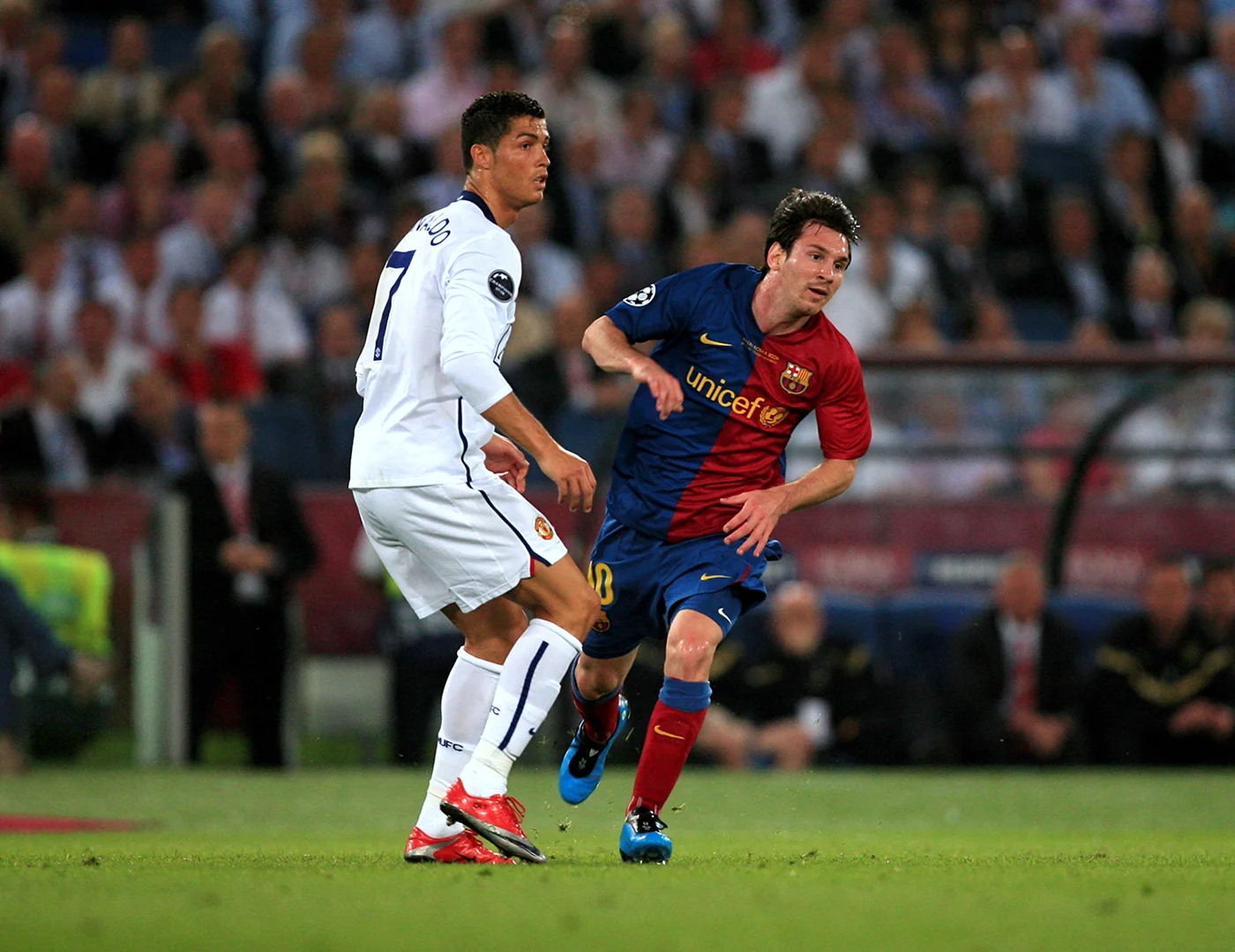
Messi and Ronaldo

Rome, 2009. The only time they would meet in a Champions League final.

Photo: Ph.FAB / Shutterstock

The question is no longer who is the greatest? By every available empirical measure, that question is too close to call. The data instead answers a different question: why do people disagree about it? And the answer is that the disagreement is patterned. Where you live shapes who you call the GOAT. So does who you are. And the two layers, geography and individual values, point in the same direction.

Across 26 countries, Messi and Ronaldo have come to embody two answers to what greatness should mean. One is about work, will, and individual dominance. The other is about vision, collective play, and the perfect pass. People sort themselves between these two answers in ways that line up with their politics, their media diets, and the cultural textures of the places they live. The pattern is sharper among younger respondents than older ones, a finding consistent with a body of research on how political identity has come to infuse non-political domains. The debate, for all its noise, is doing serious cultural work.

This survey can show that the pattern exists. It cannot prove what causes it. It cannot resolve which player is actually greater. That question is empirical, and the empirical answer is too close to call. And it cannot speak to how preferences change as the players age, retire, and pass into football memory. These are real limits, and the findings should be read inside them.

What is left, then, is the argument itself. Who is the greatest? depends on what greatness means to you. That is the question this survey does not answer. It only shows that the people answering it are not answering it alone.

Image credits: Photo of Cristiano Ronaldo and Lionel Messi by Ph.FAB / Shutterstock. All images used under editorial license.


About the study
About the researcher
Saifuddin Ahmed

Saifuddin Ahmed

Associate Professor, Nanyang Technological University
Lead researcher and corresponding author

Dr. Ahmed studies how political values shape what people believe, consume, and care about — from deepfakes and misinformation, to social media's effects on political engagement, to the surprising places politics turns up in ordinary cultural life.

His research has been covered in international outlets including Yahoo News, MSN, Fox News, and The Conversation, and he has received regular coverage in Singaporean media including The Straits Times and CNA (over 50 reports to date). He has also been quoted as an expert commentator in The New York Times.

Contact: sahmed@ntu.edu.sg · Singapore

Especially happy to discuss the country-level patterns, the age cohort findings, and the cultural readings of Messi and Ronaldo.

Read the paper

The full preprint.

The preprint contains the full methodology, model output, supplementary materials, and instrument details.

Read on SSRN →
Methodology

How the study was done.

Sample

Cross-national online survey conducted between April and May 2026, with 10,661 respondents drawn from quota-sampled panels in 26 countries spanning six continents. Country selection prioritized variation in football culture, political systems, and economic development. Within each country, samples were balanced for age and gender to approximate national adult distributions.

Measurement

Each respondent rated both Lionel Messi and Cristiano Ronaldo on a 1–7 favorability scale, in randomized order. The primary outcome is the within-person difference between the two ratings. Additional measures captured demographics, political ideology, media-use habits, and a set of validated personality and cognition scales/items. Full instrument details are in the preprint's supplementary materials.

Analysis

Country-level differences were tested via paired-samples t-tests with Benjamini–Hochberg correction. Individual-level predictors (political ideology, demographics, media use, personality, and cognitive reflection) were examined using a two-level mixed-effects model that accounts for both the country someone is from and their individual characteristics. Full coefficients and model fit are reported in the preprint.

Where we surveyed

Twenty-six countries, six continents.

Our sample spans a range of football cultures, political systems, and levels of economic development.

Asia-Pacific
9 countries
AUAustralia
CNChina
INIndia
IDIndonesia
JPJapan
MYMalaysia
PHPhilippines
SGSingapore
KRSouth Korea
Europe
8 countries
FIFinland
FRFrance
DEGermany
NLNetherlands
NONorway
PTPortugal
ESSpain
GBUK
Americas
5 countries
ARArgentina
BRBrazil
CACanada
MXMexico
USUS
Africa & Middle East
4 countries
EGEgypt
NGNigeria
ZASouth Africa
TRTurkey
Notable absences include Russia, the Gulf states, and most of sub-Saharan Africa beyond Nigeria and South Africa. The 26-country sample represents football cultures with substantial global media presence and online survey infrastructure, rather than all football-watching populations.
Disclaimer

This website presents an independent academic study and is not affiliated with, sponsored by, or endorsed by Lionel Messi, Cristiano Ronaldo, their clubs, leagues, sponsors, teams, or representatives. Images of public figures are licensed from Shutterstock and used for editorial and educational purposes only. All image rights remain with their respective copyright holders.

Beyond the survey
01 · The Language of Fandom

Two camps, one sport

Posts from 40+ football and country subreddits surface evaluative language in its original tongue. Spanish rey and mejor, Portuguese fenômeno, French beau and meilleur, Italian migliore sit alongside English descriptors, each sized by how statistically distinctive it is to that community.

Messi fans — across Reddit
Ronaldo fans — across Reddit
98,216
Words analysed · Messi posts
100,792
Words analysed · Ronaldo posts
Sources: r/Messi, r/CristianoRonaldo, r/soccer, and 40+ country subreddits. Words appear in their original language — Spanish, French, Portuguese, and Italian terms included alongside English. Sized by statistical distinctiveness (log-odds with Dirichlet prior; Monroe et al. 2008). 100 distinctive descriptors from 199,008 words · Reddit · May 2026.

The words fans reach for reveal different ideas about what greatness even means. CR7's community gravitates toward physical and performative language: beau (beautiful), mentality, machine, speed. Messi's community leans toward the aesthetic and the symbolic: dribbling, magical, rey (king in Spanish), mejor (best). While both camps are enthusiastic, they are arguing about different versions of the GOAT: one about athletic spectacle, the other about artistry and legacy.





















